DepoDart — Subsurface Intelligence
A 3D website you scroll through like a story — and feel an AI mining model work under your cursor.
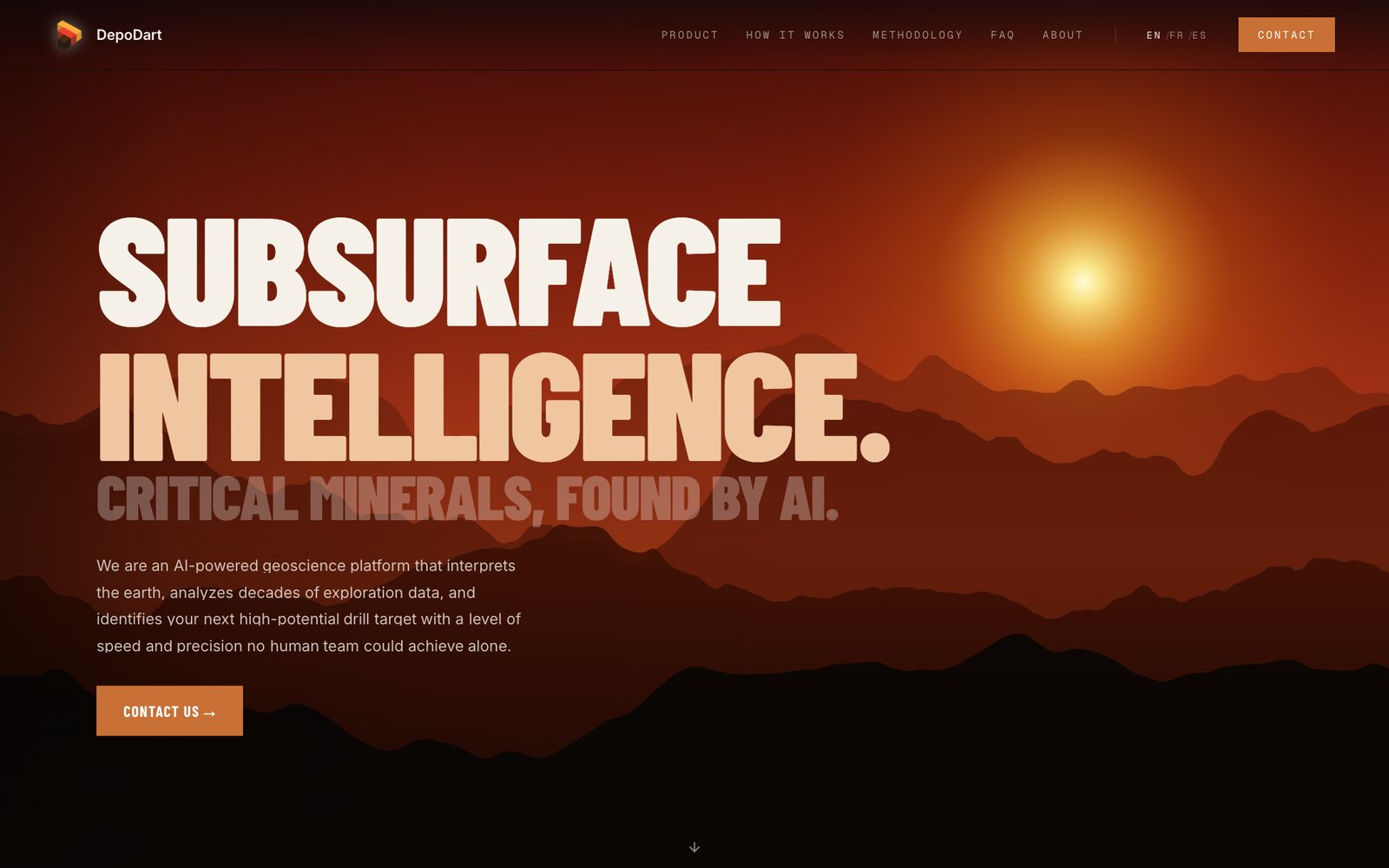
DepoDart is an AI company that helps mining teams decide where to drill. This is its website, depodart.com, which I built in 2026: a 3D scroll-driven site in English, French and Spanish, on Next.js 15, React 19 and three.js with custom GLSL shaders.
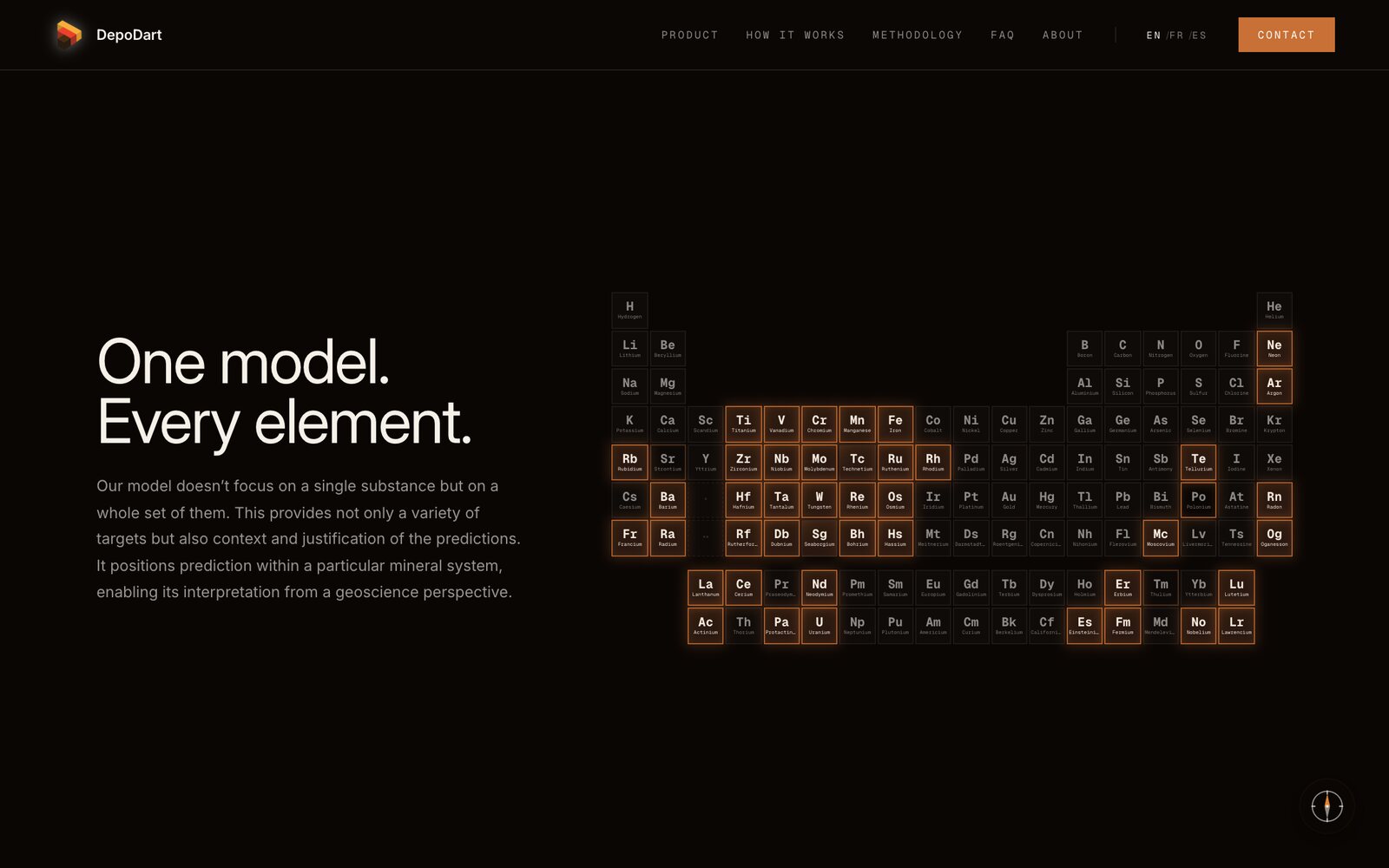
The website for DepoDart — an AI company that reads decades of mining exploration data and points to the best place to drill next. The challenge: make an invisible AI model feel real. The answer: a website you scroll through like a story, where each chapter is its own live 3D scene — a landscape that peels back to a heat map under your cursor, a wall of raw data turning into ranked targets, and a periodic table that lights up with every element the model can predict.
- Role
- Frontend & 3D developer
- Timeline
- 2026
- Stack
- Next.js 15 (static export) · React 19 + TypeScript · three.js + R3F · Custom GLSL shaders · GSAP + ScrollTrigger · Lenis smooth scroll · Zustand · next-intl (EN / FR / ES) · Cloudflare Pages
The brief
Make an invisible model feel real.
What DepoDart is.
DepoDart is an AI platform for the mining industry. It studies decades of exploration data — measurements, maps, old drill records — and tells a mining team where to drill next. The brief: build a website that makes that abstract idea something you can actually feel. So the homepage became a long scrolling story, where every chapter is its own live 3D scene instead of a screenshot in a box.
Why tell it as a story.
"AI finds minerals" is a claim you can't photograph. So the site lets you do the model's job with your own cursor — peel the landscape back to a heat signature, tap the map to sample a probability, watch raw data become ranked drill targets. The pitch lands as an experience, not a paragraph.
The story it tells
Mining runs on incomplete information.
The real problem, told in scroll.
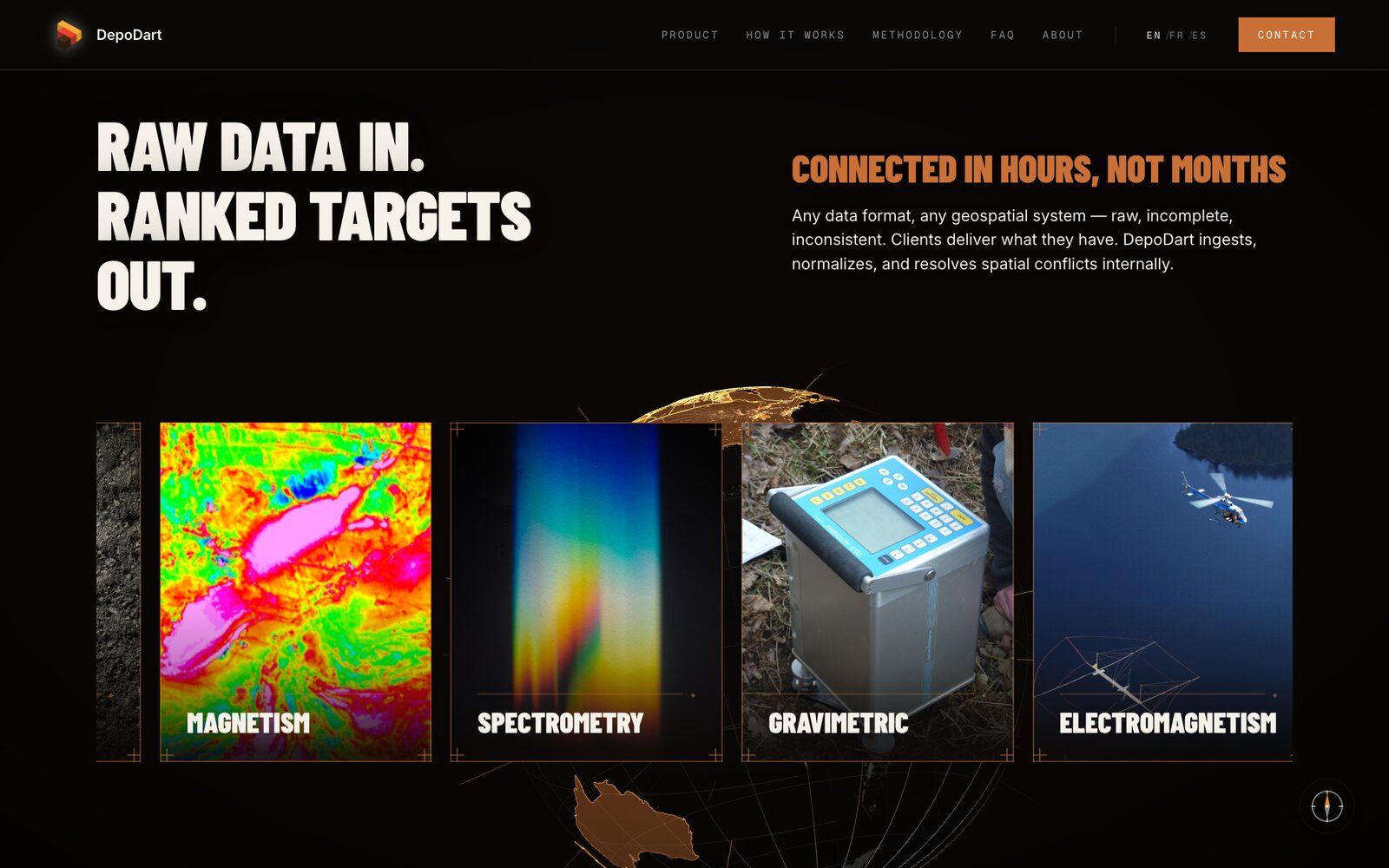
Drilling is expensive — a huge budget goes into a handful of holes. Meanwhile, decades of useful measurements sit in archives, in formats that don't match and maps that don't line up. DepoDart finds the patterns buried in all that data and turns them into a target on a map. The site walks you through exactly that journey: raw data in, ranked targets out.
DepoDart's argument, in four steps.
- Not a black box — Every prediction shows the data that led to it — you can see why the model points where it points.
- Raw data in, ranked targets out — Any format, any map system — cleaned up and lined up onto one common grid in hours, not months.
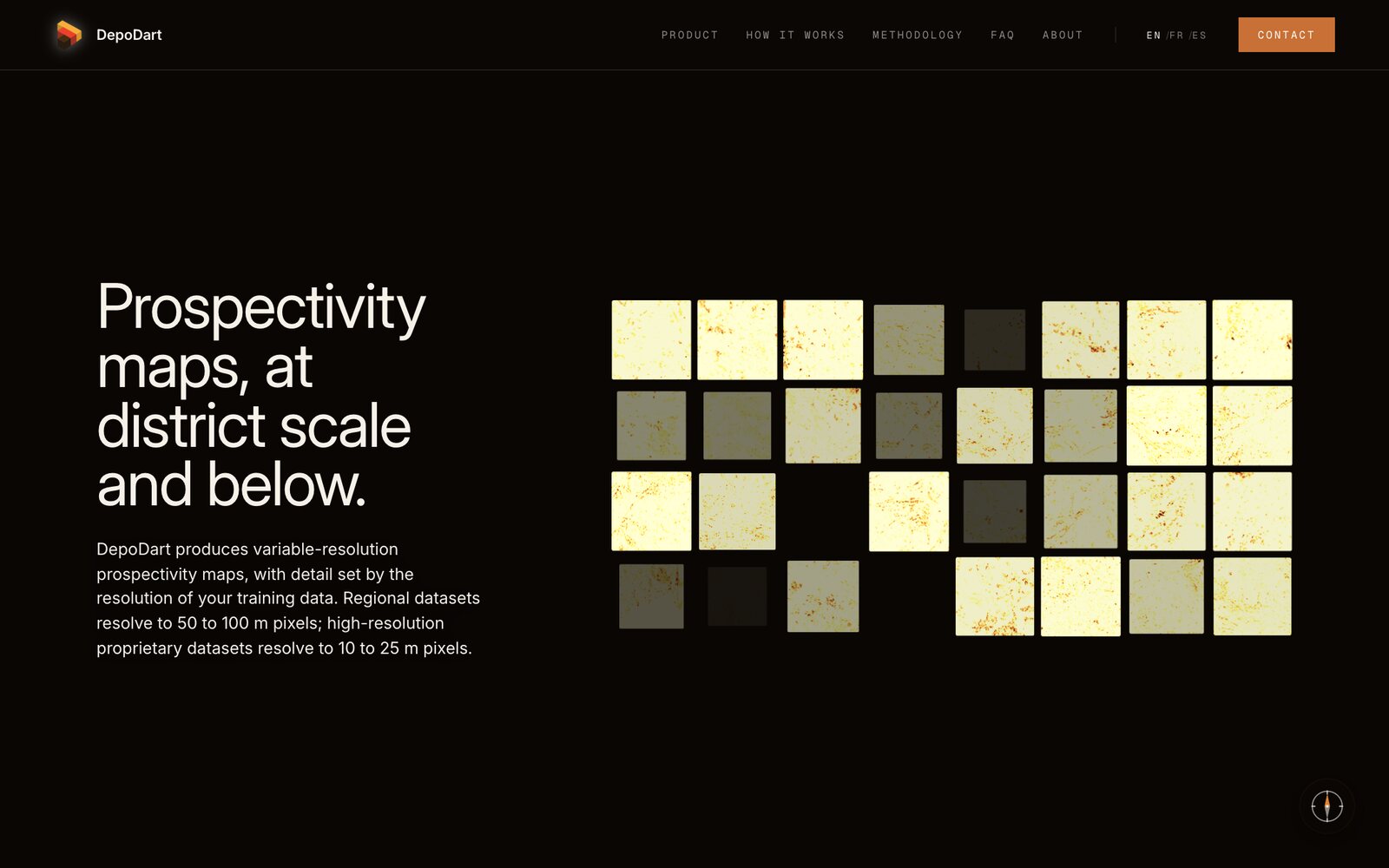
- Sharp, local detail — Probability maps from a wide regional view down to 10–25 meter detail on a company's own data.
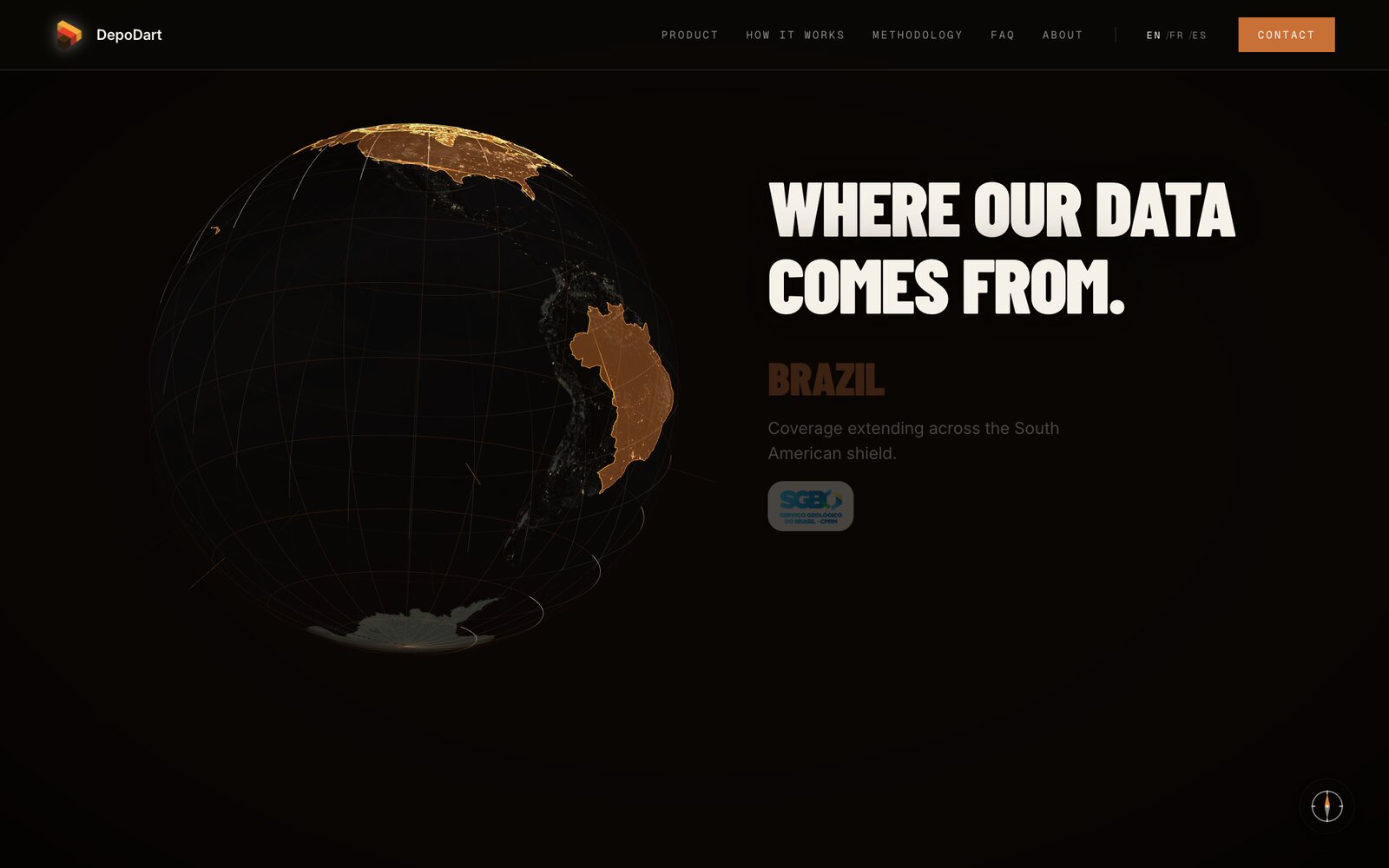
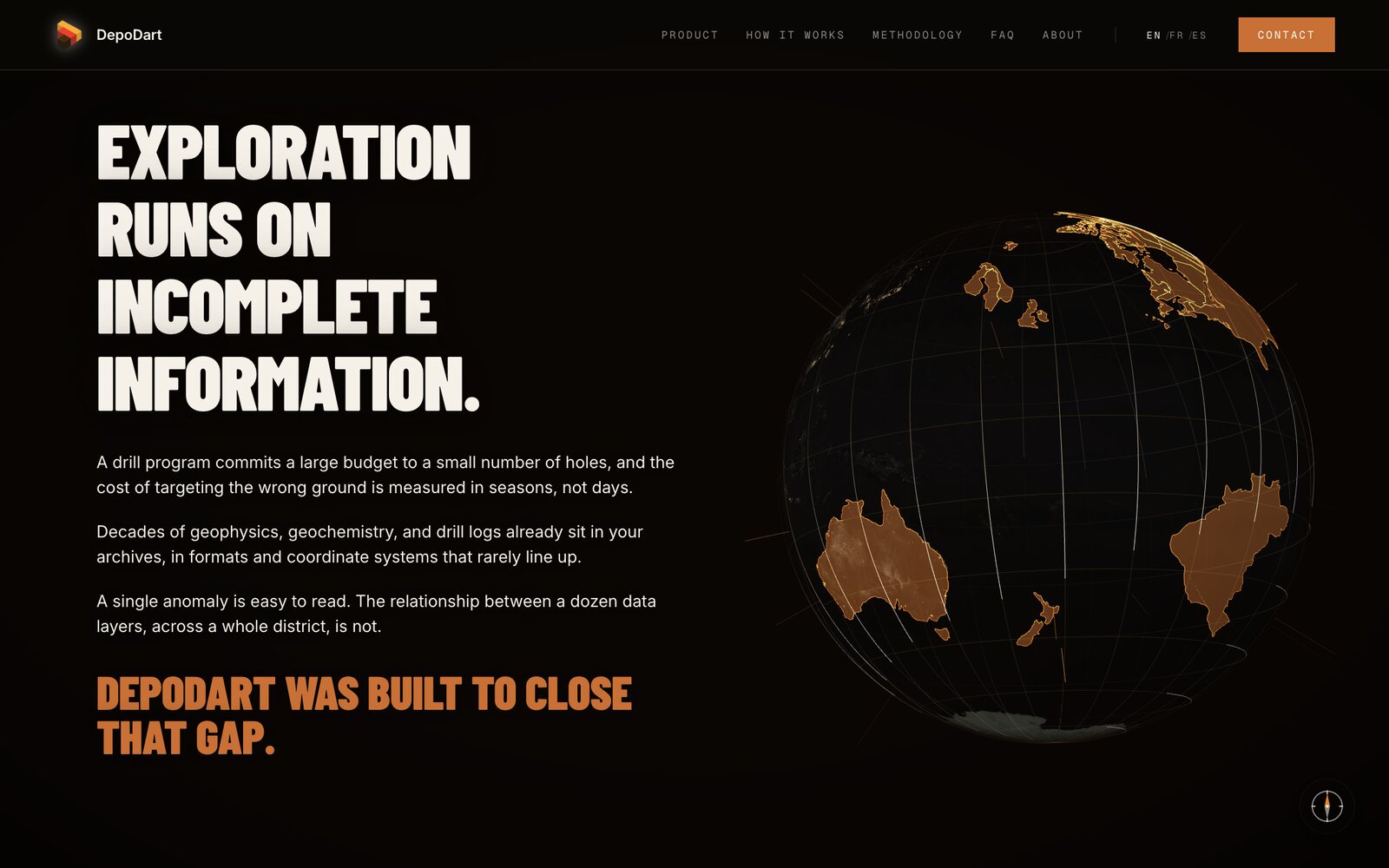
- 37.8 million km² — The models learned from open survey data across Canada, the US, Brazil, Australia, New Zealand, and northern Europe — about a quarter of Earth's land.
Coverage
Trained on a quarter of Earth's land.
37.8 million square kilometers.
DepoDart states that its models learned from decades of public survey data from Canada, the United States, Brazil, Australia, New Zealand, and northern Europe — 37.8 million km², about a quarter of Earth's land, more than twice the size of Russia. On the site, that's a glowing wireframe globe that lights up region by region as you scroll.
How it's built
Each chapter is its own 3D scene.
Independent scenes, careful cleanup.
Instead of one big 3D engine running the whole page, every chapter runs its own — and shuts it down completely when you scroll past. That cleanup matters: 3D graphics eat memory fast, and without it a long page like this would slow to a crawl. Here, each scene hands its memory back the moment it leaves the screen.
Heavy on the graphics card, light on the network.
The pages themselves are simple, pre-built files served from a worldwide network — they load fast everywhere. All the heavy 3D work happens on your own device's graphics chip, written in small custom graphics programs made for each scene.
Motion
Everything moves on the same heartbeat.
One clock for all the motion.
The smooth scrolling, the pinned chapters, and the animations all advance on one shared clock. Without that, the different systems drift slightly apart and the page feels subtly off. With it, every scene lands exactly where the scroll says it should — every frame.
Reduced motion, taken seriously.
For visitors who turn on their system's "reduce motion" setting, the site genuinely calms down: scrolling becomes instant, every scene jumps to its finished state, the custom cursor steps aside, and the heaviest 3D scene simply doesn't run. The story still reads top to bottom — just without the fireworks.
Languages
English, French, and Spanish — always in step.
Three languages, no drift.
The site ships in three languages, each at its own address. All the text lives in translation files with English as the source of truth — and an automatic check blocks any update where a translation is missing. A new section can't go live in one language and silently break the other two.
Next project: KeyShortcut — Shortcuts Directory